

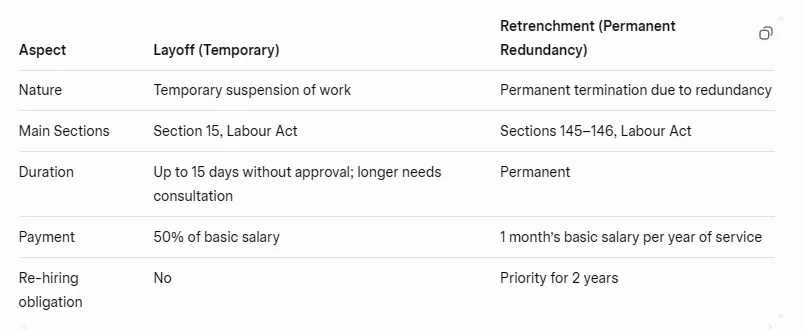
1. Difference Between Layoff and Retrenchment
2. When Do These Provisions Apply?
The layoff and retrenchment rules do NOT apply if the enterprise employs fewer than 10 workers (regular + contract combined).
3. Layoff under Special Circumstances (Section 15)
3.1 Permissible Grounds
An employer may lay off workers only in these situations:
- Shortage of power, water, or raw materials
- Lack of funds
- Inability to reach workplace due to force majeure
- Any situation beyond the employer’s control that stops operations
3.2 Approval & Duration
- Up to 15 days → No approval required
- More than 15 days → Must consult authorised trade union or Labour Relations Committee
3.3 Mandatory Notice Contents (Rule 5)
- Reason for layoff
- Expected duration
- Names, positions, department of affected employees
- Confirmation of 50% basic salary payment
- Any other relevant information
3.4 Financial Obligation
- 50% of basic salary (includes grade/annual increment, excludes allowances)
- Employees are exempt from attending work unless the notice says otherwise
4. Retrenchment / Permanent Redundancy (Sections 145–146)
4.1 Valid Grounds
- Severe financial difficulty
- Employees become redundant due to merger or restructuring
- Partial or complete shutdown of the enterprise
4.2 Mandatory 30-Day Prior Notice
Must be given separately to:
- Labour Office
- Authorised trade union (or Labour Relations Committee if no union exists)
The notice must contain:
a) Grounds for retrenchment
b) Probable date of retrenchment
c) Number of workers to be retrenched
4.3 Step-by-Step Approval Process
(Insert the original Annex I flowchart image here with alt text: “Retrenchment approval process flowchart Nepal 2025”)
4.4 Order of Retrenchment (Section 145)
Unless otherwise agreed with the union:
- Foreign workers first
- Workers with more disciplinary punishments
- Workers with poor performance
- Last In, First Out (LIFO) within the same category Exception: Earlier appointees can be retrenched first only with recorded justification.
Office-bearers of the authorised trade union and Collective Bargaining Committee are retrenched last.
4.5 Severance / Retrenchment Compensation
- One month’s basic salary for each completed year of service
- Pro-rata for incomplete years
- Paid in addition to gratuity, unused leave, etc.
- No compensation if the employee is eligible for unemployment benefits under Social Security Fund (SSF)
4.6 Re-hiring Priority (Section 146)
If the enterprise resumes the same work or hires again within 2 years, previously retrenched workers get first priority.
5. Common Mistakes that Lead to Reinstatement + Back Wages
- Retrenchment without 30-day notice or Labour Office approval (when ≥10 workers)
- Wrong calculation of severance pay
- Discriminatory selection (targeting union members, pregnant employees, etc.)
- Not following LIFO order without justification
6. Quick Compliance Checklist for Employers (2025)
- Document genuine business reason
- Issue 30-day notice to Labour Office & union
- Consult union/committee on alternatives
- Follow correct retrenchment order
- Pay full severance + all dues on the last working day
- Keep records for at least 5 years
7. Frequently Asked Questions
Q: Can we retrench workers on probation or fixed-term contracts?
A: Fixed-term contracts end naturally. Probationers can be terminated under Section 11 without retrenchment process.
Q: Is approval needed for laying off 8 workers in a 50-employee company?
A: Yes — any retrenchment in enterprises with ≥10 workers needs approval.
Q: Can severance be adjusted against SSF unemployment benefits?
A: No. If SSF unemployment benefit applies, no separate retrenchment compensation is required.